There’s no denying it anymore, AI tools like ChatGPT and image generators have changed the way people approach design. For small businesses, start-ups, clubs, events and side hustles, they offer something genuinely useful: speed. You can turn a rough idea into a visual concept in minutes instead of days.
And honestly? That’s not a bad thing.
As a starting point, AI can be brilliant. It helps people communicate ideas they might otherwise struggle to explain. It can generate mood boards, slogans, layout concepts, colour ideas and rough visuals quickly and cheaply.
But there’s a big difference between having an idea and having something that’s actually ready for branding, embroidery, garment printing or professional production.
That’s where the problems begin.
AI Is Good at Inspiration — Not Production
One of the biggest misconceptions we see in the print industry is the belief that an AI-generated image is automatically “print ready”.
Usually, it isn’t.
Most AI artwork is created purely for screens. It may look sharp on a phone or laptop, but once you try to enlarge it for a hoodie back print, embroidery file or large-format garment print, the issues become obvious:
- Low resolution
- Blurry edges
- Poor colour separation
- Impossible gradients
- Tiny unreadable details
- Fake vector effects
- Distorted text
- Layering issues
A design that looks fantastic on Instagram can become completely unusable once it hits an actual production workflow.
Professional garment printing requires knowledge of:
- Print methods
- Fabric behaviour
- Ink limitations
- Colour profiles
- File setup
- Bleed areas
- Placement restrictions
- Vector conversion
- Stitch counts for embroidery
- Garment seams, zips and pockets
AI doesn’t understand these things unless the user specifically asks for them, and most people don’t even know they need to ask.
“Make It Look Like Nike” Is a Legal Minefield
Another growing issue is copyright and trademark infringement.
A lot of prompts now sound something like:
“Make me a logo like Nike”
“Create a design inspired by Supreme”
“Make this look like Disney/Pokémon/Marvel”
That might seem harmless, but professionally speaking, it’s a massive red flag.
AI models are trained on huge amounts of existing visual material. Because of that, generated designs can unintentionally resemble protected branding, copyrighted artwork or trademarked styles far too closely.
Even if the similarity is accidental, the liability usually lands on the business using the artwork, not the AI software.
That means:
- Takedown requests
- Refused print jobs
- Trademark disputes
- Marketplace bans
- Rebranding costs
- Legal complications
A proper designer knows how to create something inspired by a style without directly copying someone else’s identity.
That distinction matters.
The “Samey” Branding Problem
We’re also starting to see another side effect of AI-generated design:
Everything is beginning to look the same.
The same fonts.
The same glowing gradients.
The same minimalist logos.
The same “modern” layouts.
The same flyer styles.
When businesses rely entirely on AI prompts without creative direction, branding becomes generic very quickly. Ironically, the easier design becomes, the harder it is to stand out.
Good branding isn’t just about looking “nice”.
It’s about:
- Recognition
- Personality
- Memorability
- Audience targeting
- Consistency
- Longevity
A strong brand should feel unique to your business, not like a slightly different version of 500 others online.
AI Doesn’t Replace Experience
There’s also something AI can’t replicate very well yet: practical production experience.
For example:
- A design may cross over hoodie zips and become unreadable.
- Fine details may disappear during DTF printing, be unusable in vinyl.
- Metallic effects might not exist in real ink.
- Colours on-screen may print completely differently on fabric.
- Embroidery may require simplifying the artwork entirely.
- Oversized back prints may crack or peel if designed incorrectly.
These aren’t “creative” problems, they’re manufacturing realities. An experienced print designer understands the difference between what looks good digitally and what will actually work in the real world.
So Should People Use AI for Design?
Absolutely, but properly.
AI works best as:
- An idea generator
- A brainstorming tool
- A concept starter
- A communication aid
- A way to explore styles quickly
Where people get into trouble is treating AI output as the finished product.
The best results usually happen when AI and professional experience work together:
- Use AI to explore ideas.
- Refine the concept with a designer.
- Prepare artwork correctly for production.
- Ensure branding is original, practical and legally safe.
That process saves time and avoids expensive mistakes.
Final Thoughts on AI and Design
This isn’t about being anti-AI. The technology is impressive, useful and here to stay.
But in the same way owning a calculator doesn’t make someone an accountant, having access to AI image generation doesn’t automatically make a design production-ready.
Good design is still more than typing a prompt.
It’s understanding branding, print methods, materials, copyright, production limitations and real-world application.
AI can generate an image.
Experience turns it into a usable product.
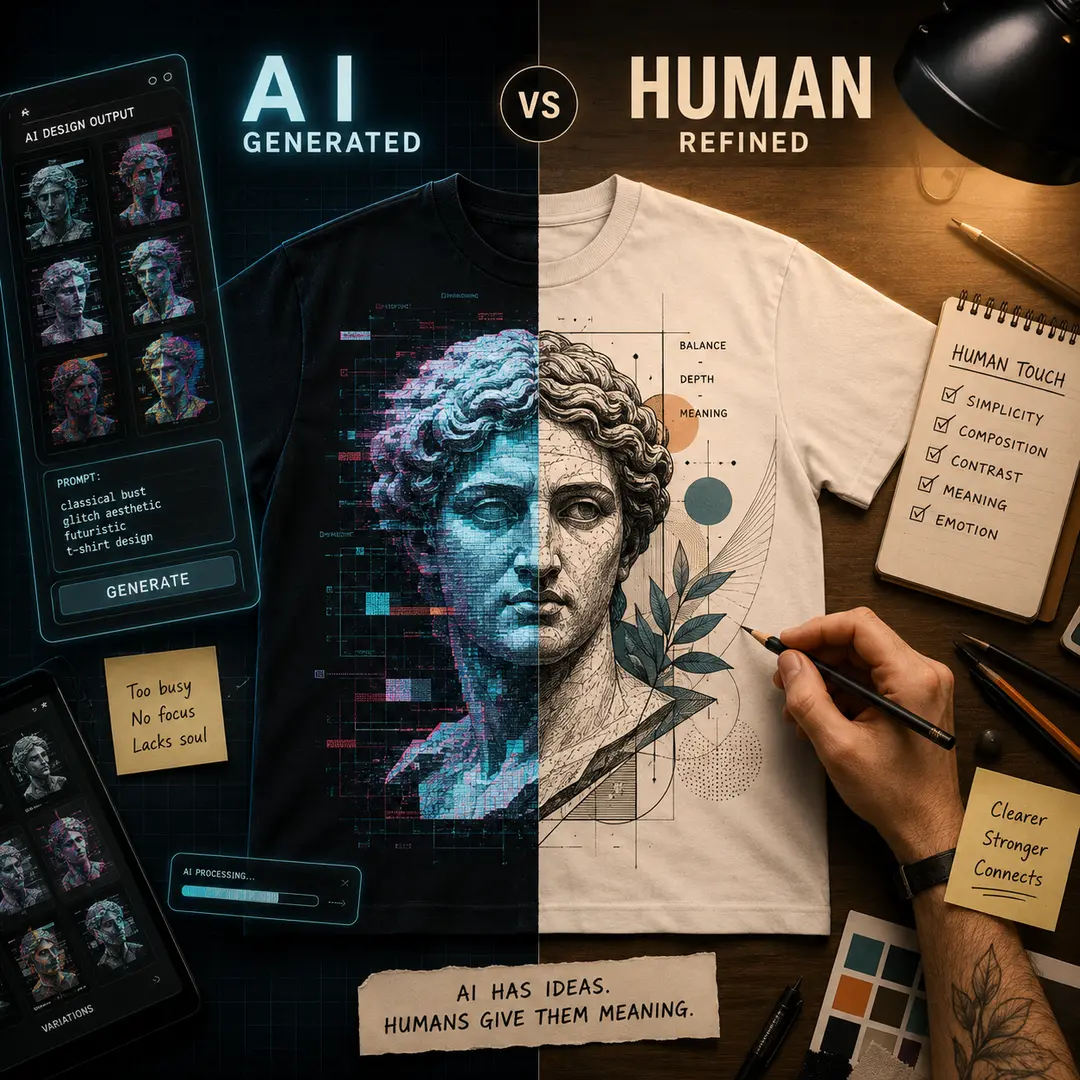
In the interests of full disclosure, we used AI to help focus our points in this article, couldn’t do the whole thing, it needed editing but it is a brilliant tool used right. We used it for the image as it felt right to let it have a go. The prompt was ” I’ve just written this article (with your help) https://tynesidetshirts.co.uk/why-ai-generated-logos-and-t-shirt-garment-design-still-need-a-human-eye/ and as a final touch of irony I’d like to get you to design my featured pic. needs to be 1080x1080px but other than that I don’t really have any really requirements. As to not leave it totally up to you I’ll only add, show me AI design in an image. Read my article for inspo, but show me what you’ve got. Thank you”. The end result? Was the wrong size and didn’t really fit the brand, but sells what we’re saying in the post so…